

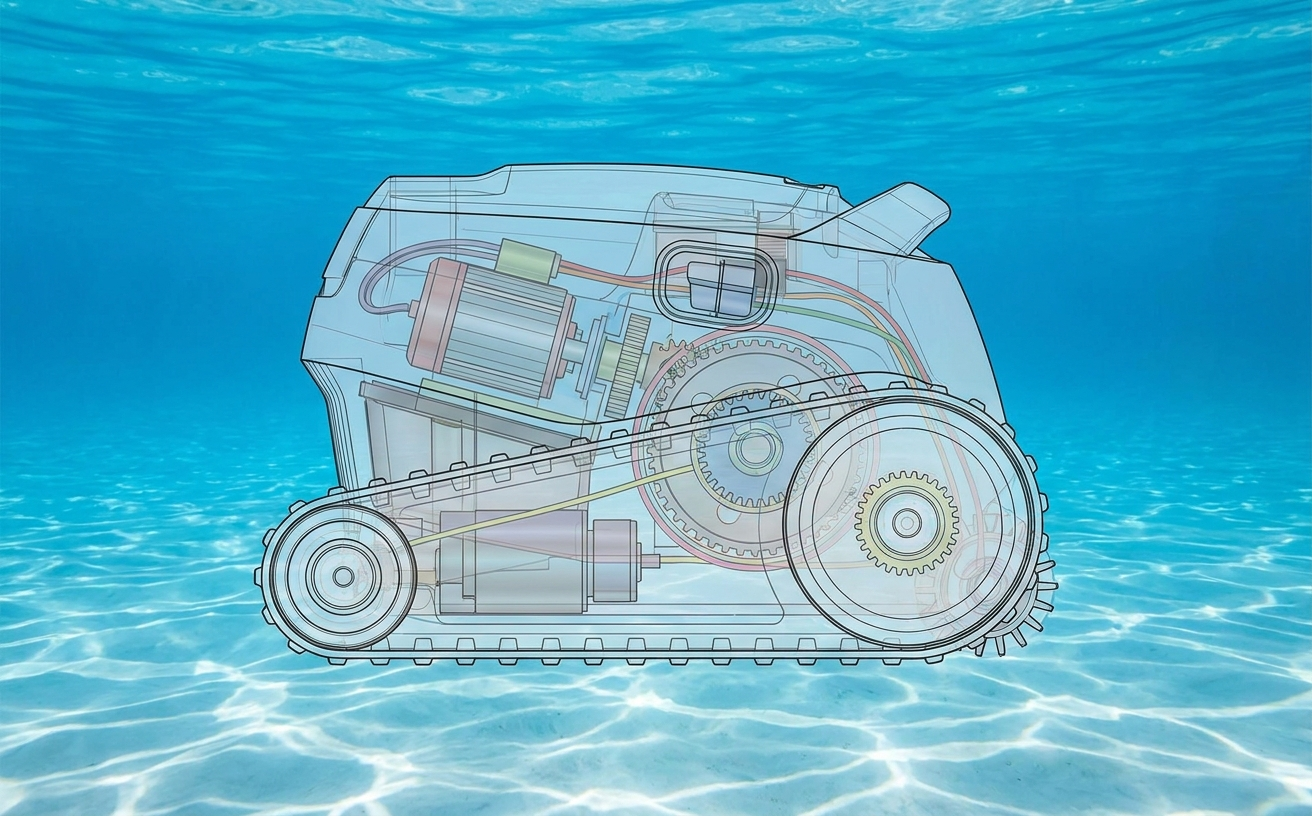
A robotic pool cleaner is a waterproof vehicle that navigates underwater, filters debris from the water, and powers itself through a cable connected to a surface transformer. Each of these functions involves engineering trade-offs that affect reliability, performance, and longevity. Understanding these trade-offs helps you evaluate cleaners on their actual engineering merits rather than marketing claims.
The three core systems are locomotion, filtration, and power delivery. How well each is implemented determines whether the cleaner performs consistently for years or declines after the first season.
Locomotion: Getting From Here to There Underwater
Underwater locomotion presents challenges that land vehicles do not face. Water resistance slows acceleration and limits top speed. Buoyancy reduces traction on the pool floor. Chemicals in the water corrode exposed metal parts. The drive system must overcome all of these while maintaining directional control.
Two-wheel differential drive is the most common locomotion configuration. Each wheel is powered by an independent motor, and steering is achieved by varying the speed of each wheel. This is simple, reliable, and allows the cleaner to turn in place. The limitation is that two-wheel designs can become stuck in drains, on slopes, and against obstacles that wedge between the wheels.
Four-wheel and tracked configurations improve obstacle clearance and slope climbing but add complexity and weight. More moving parts means more potential failure points. For most residential pools, a well-designed two-wheel system with appropriate wheel diameter and rubber traction rings is sufficient and more reliable than a complex tracked system.
Filtration: Capturing Debris at the Source
The filtration principle is straightforward: draw water in through an intake, pass it through a filter medium, and expel it. The intake is positioned on the bottom of the cleaner, directly against the pool floor, where debris is concentrated. The filter captures particles larger than its micron rating, and the expelled water creates thrust and stirs up settled debris.
The critical engineering decision is filter micron rating versus filter capacity. A two-micron filter captures more debris but clogs faster. A fifty-micron filter captures less debris but holds much more before clogging. The ideal balance depends on the typical debris in your pool. Sand and silt require fine filtration. Leaves and insects require coarse filtration with high capacity.
Some cleaners offer dual filters: a coarse outer filter that captures large debris and a fine inner cartridge that captures small particles. This is the most versatile configuration because it handles both types of debris without requiring the owner to choose between fine and coarse filter cartridges.
Power Delivery: Electricity Through a Cable Underwater
Delivering electrical power through a cable that is submerged in chemically treated water is the most challenging engineering problem in robotic pool cleaner design. The cable must be waterproof, flexible enough to coil without kinking, and durable enough to withstand years of sunlight and chemical exposure.
The transformer on the surface converts household voltage to a safe low voltage, typically twenty-four to thirty-six volts. This low voltage cannot cause dangerous electrical shock, which is why robotic cleaners are inherently safer than pool cleaners that connect to the high-voltage booster pump. Anyone researching how robotic pool cleaners work should understand that the low-voltage design is a fundamental safety feature, not just a technical detail.
The connection point between the cable and the cleaner body is the most vulnerable to water ingress. This is where most cable-related failures occur. Dual-seal connections with redundant gaskets provide better protection than single-seal designs. The difference is invisible during normal operation but becomes apparent after two or three seasons of use.
Navigation: Covering the Floor Efficiently
Navigation in a robotic pool cleaner ranges from purely random to semi-systematic. Random navigation relies on probability: if the cleaner moves long enough, it will eventually pass over every part of the floor. Systematic navigation uses sensors to track position and follow a pattern.
Random navigation is simpler and less expensive but requires longer run times to achieve full coverage. Most random-pattern cleaners need two to three hours to cover a typical residential pool floor. Systematic navigation can cover the same floor in one to two hours because it does not waste time revisiting areas already cleaned.
The practical difference is smaller than the marketing suggests. Both approaches achieve full coverage given adequate run time. The advantage of systematic navigation is efficiency, which translates to slightly lower wear per cleaning cycle because the machine runs for a shorter duration.
Thermal Management: Keeping the Pump Cool
The pump motor generates heat during operation. In a robotic pool cleaner, the motor is cooled by the water flowing through the pump. If the filter is clogged and water flow is restricted, the motor cannot dissipate heat effectively and will overheat.
Most modern cleaners include a thermal cutoff switch that shuts the motor down when it reaches a critical temperature. This protects the motor from permanent damage but leaves the cleaner stranded in the pool until it cools down and can be restarted. Repeated thermal shutdowns stress the motor winding insulation and shorten its life.
The engineering solution is straightforward: keep the filter clean. A clean filter allows full water flow, which keeps the motor at a safe operating temperature. The thermal cutoff is a safety net, not a routine operating mode. If your cleaner shuts down from overheating regularly, the filter needs more frequent cleaning.
What Engineering Quality Looks Like
Engineering quality in a pool robot is not about feature count or specification numbers. It is about how well the basic functions are executed and how gracefully the machine handles the stresses of real-world use.
- Double-sealed cable connections that prevent water ingress at the most vulnerable point
- Top-access filter compartments that encourage regular cleaning
- Swivel cable connections that prevent tangling
- Thermal protection that engages before damage occurs
- Drive belts that are accessible for inspection and replacement
These engineering choices cost more to implement, which is why they appear on mid-range and premium models. But they determine whether the cleaner is a reliable tool that improves with familiarity or a disposable device that declines with use. The engineering is invisible when it is done well and painfully obvious when it is not.
